EHDS binding since March 2025FHIR in 71% of EU countriesPrimary use from March 2029Since 2019IDSAGaia-XDCAT-AP
Use Cases
From legislation to clinical practice
Eight use cases: from structured referrals to AI agents. Each solves a concrete trust and contract question.
Primary Use
Structured Referral
Referral letters as FHIR bundles instead of faxes: encrypted, with patient consent, delivered in under 30 seconds.
< 30s transfer-60% queries
Secondary Use
Quality Registries & Benchmarking
Anonymized treatment outcomes in peer comparison. Medical chamber as trustee.
> 70% participationPPRL secured
Primary Use
Tumor Board & Second Opinion
Structured case discussion in encrypted Matrix rooms. DICOM images securely referenced.
3 days instead of 14E2EE Matrix
Secondary Use
Research Data Access via HDAB
Standardized data access for research. Federated catalog, automated approval, secure processing.
Weeks instead of months1 policy instead of n contracts
Primary Use
Cross-Border Patient Summary
Patient data available cross-border. IPS via MyHealth@EU, retrieved in seconds.
< 10s availabilityEUDI Wallet
Agentic
AI-assisted Diagnostics
Diagnostic agents as controlled participants with their own credentials, policies, and audit trail.
Agent VC per accessAI Act compliant
Secondary Use
Pharma Real-World Evidence
Regulated evidence generation from real-world data. Pseudonymized, in secure processing environments.
Millions of recordsDiff. Privacy
Agentic
Public Health Surveillance
Real-time syndromic data for early detection. Surveillance agent detects anomalies before reporting chains kick in.
Hours instead of weeksAggregates only
Regulatory Context
The EHDS regulation is mandatory for all 27 member states
Regulation (EU) 2025/327 has been in force since March 2025. Unlike a directive, it applies directly, with no national transposition required.
March 2025
Regulation enters into force
EHDS Regulation published in the Official Journal. Directly applicable in all 27 member states.
June 2025
National authorities designated
Each member state designates a National Digital Health Authority (NDHA).
March 2027
Implementing Acts & EEHRxF
Commission adopts implementing acts. European Electronic Health Record Exchange Format (EEHRxF) formally established.
March 2029
Primary use goes live
MyHealth@EU: Patient summaries, ePrescriptions, eDispensation available cross-border.
March 2031
Full deployment
Medical images, lab results, hospital discharge reports. Full interoperability.
Primary Use
MyHealth@EU
The patient at the center. A patient in Vienna should be able to access their records from Munich: structured, machine-readable, in real time. Eleven member states already exchange patient summaries.
Secondary Use
HealthData@EU
Health data for research and innovation, via Health Data Access Bodies (HDABs) as national gatekeepers. Opt-out instead of opt-in. In Germany, the GDNG enables access to data on 75 million insured people.
The Problem
Six gaps between regulation and reality
🔌
Interoperability
71% of EU countries use FHIR, but each with its own versions, profiles, and terminologies. ICD-10-GM, SNOMED CT, CDA: a tower of Babel in healthcare.
🏛
Governance
Every member state needs at least one HDAB. Most start from scratch: staff, software, and processes still have to be built. Frameworks need software to operationalize them.
✍️
Consent
Three consent models side by side (Tiered, Broad, Opt-out), but most hospitals manage consent on paper. Consent digitally linked to policy enforcement remains the exception.
🔒
Security
Ransomware attacks on hospitals tripled between 2022 and 2025. Every new EHDS API is a new attack vector. Legacy systems from the 2000s now face security requirements at financial-sector level.
🌐
Decentralization
27 member states, 27+ HDABs, thousands of data holders, hundreds of thousands of researchers, all connected via a federated network. Without standardized software infrastructure, this is unsolvable.
🤖
AI Agents
AI agents increasingly access health data autonomously, often without clear authorization, dedicated credentials, or an audit trail. Neither the GDPR nor the EHDS fully addresses this gray area.
nexyo makes trust operational: with a formula of four components.
Trust Layer
Trust is not a feeling. It is a formula.
Every component must be technically implemented, organizationally governed, and legally secured. If one is missing, trust is missing.
Trust=Identity+Agreement+Enforcement+Audit
Identity
Who is the participant? Four-tier Credential Cascade: eIDAS 2.0, EUDI Wallet, W3C DID, Verifiable Credentials. Every participant, human or agent, carries a cryptographically signed credential.
Agreement
Under what conditions? ODRL policies encode purpose limitation, region, duration, anonymization. Machine-readable and enforceable, replacing legal prose in PDFs.
Enforcement
Is the agreement enforced? Policy Engine (OPA) checks every access in real time. Attribute-level enforcement down to FHIR field level. Automatic consent linkage.
Audit
Is everything provable? Every access is recorded in a tamper-proof log: who, which data, under which policy, when, with what result. Directly exportable for HDABs and the EU Commission.
Credential Cascade for Health
Trust is delegated level by level: from the EU through the medical chamber down to the individual participant.
From data exchange to automated compliance: four building blocks
Block A
FHIR-native Health Data Space Platform
Sovereign health data exchange based on the EDC connector. Register FHIR servers as assets, policy engine as proxy, automatic EEHRxF validation. Three-hub model: Trust Provider, Data Provider, Service Provider.
FHIR R4EDC ProxyLegacy Mapping
Block B
HDAB-Enablement Platform
The operational foundation for Health Data Access Bodies: permit management, federated data catalog, researcher portal, compliance reporting, opt-out management. All in one system instead of email chains.
HealthDCAT-APPermit WorkflowOpt-out
Block C
Sovereign Data Exchange
EDC as foundation, multilateral policies instead of bilateral contracts (n instead of n²), multi-stakeholder orchestration for hundreds of participants. Gaia-X, IDSA, and iSHARE compliant.
Eclipse EDCGaia-XiSHARE
Block D
Compliance Agent
Automates recurring compliance checks: legal basis, HDAB approval, opt-out, format conformity. The Pattern Factory codifies patterns from every engagement into automated modules.
Pattern FactoryOPAODRL
Interoperability
FHIR-native from the ground up
nexyo processes FHIR R4 natively, without an adapter, mapping layer, or conversion step. The Data Trust Hub ingests FHIR bundles directly, validates against EU profiles, and enforces terminology compliance.
Validation
Every bundle is validated against HL7 Europe EU Base and Core Profiles. Non-conformant resources are rejected with structured feedback.
Terminology
SNOMED CT, LOINC, ICD-10: the policy engine checks whether coding systems meet EEHRxF requirements and flags deviations.
De-identification
Automatic pseudonymization for secondary use. PPRL enables cross-dataset research without exposing identities.
HL7 FHIR R4EEHRxFEclipse EDCODRLW3C DID / VCeIDAS 2.0SNOMED CTLOINCICD-10Matrix ProtocolGaia-XHealthDCAT-AP
Health Data Space Sandbox
Who we build the Health Data Space for
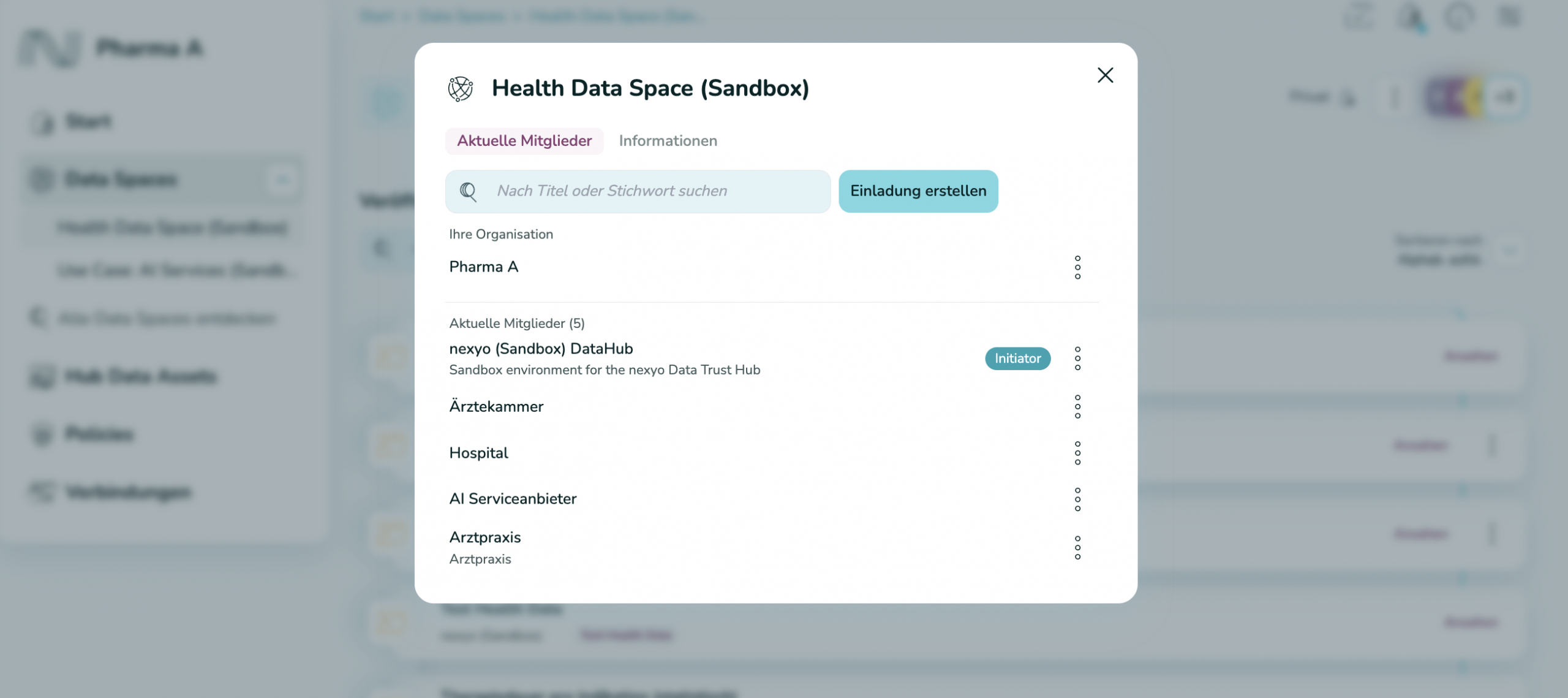
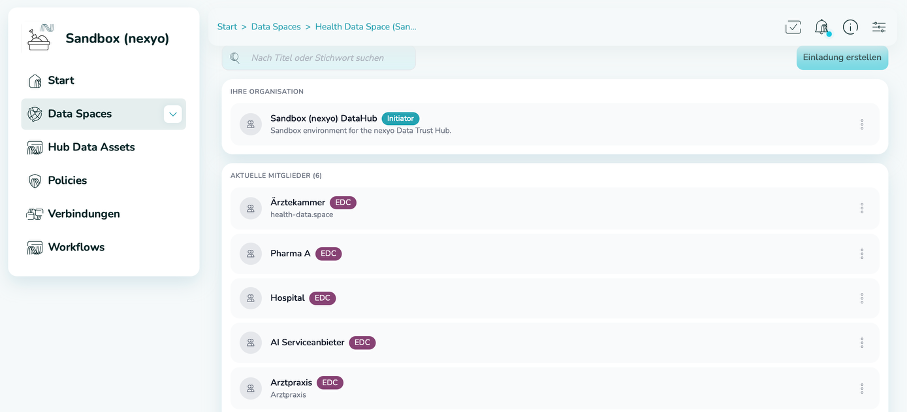
Software instead of PowerPoint: six demo organizations let you test governance, data flows, and FHIR integration in a live sandbox.
💊
Pharma
Secure exchange of sensitive research and trial data with partners, authorities, or AI service providers, legally sound and traceable.
🩺
Medical Chambers
Transparent, rule-based data transfer across the healthcare network, fostering cooperation, quality, and data sovereignty.
🤖
AI Service Providers
Access to trustworthy, compliance-ready datasets for the safe development of medical AI solutions and digital innovations.
Member overview in the Data Trust Hub
📊
FHIR-native
Process FHIR bundles with validation and terminology checks
🔒
Purpose Limitation & Consent
Granular control of usage, duration, and onward sharing
👤
De-identification
Pseudonymization and PPRL for research & analytics
⚡
Matrix Realtime
End-to-end encrypted communication in real time
⚙️
Automatable
Bots, webhooks, and bridges for seamless integration
📋
Audit-ready
Complete traceability for audits & compliance
Agentic Health
AI agents need a Trust Layer, just like humans
Diagnostic agents analyze imaging data, therapy agents evaluate patient histories, research agents search data catalogs. A Trust Layer is what makes audit, authorization, and routine operation possible.
Agent Credentials
Every AI agent receives its own Verifiable Credential with purpose, organization, and access rights.
Policy Binding
ODRL policies bind directly to agent access: diagnostics allowed, training excluded. Attribute-level granularity.
EU AI Act
High-risk AI requires transparency, explainability, and human oversight. Every agent access is auditable.
Agentic Mesh
Agent-to-agent workflows: policy checks, contract acceptance, data transfer, audit, all via Matrix.
EU AI Act + EHDS = Trust Layer obligation
The AI Act classifies AI in healthcare as high-risk. Documented risk assessments, transparent decision processes, and end-to-end traceability are mandatory. Without a Trust Layer, AI agents may not be operated in healthcare.
Governance & Compliance
nexyo operationalizes EHDS governance
Six governance functions that make the EHDS manageable for data holders, HDABs, and participants.
📋
Permit-Management
Standardized approval process for secondary use. Automatic compliance checks, transparent status tracking.
🔍
Federated Data Catalog
Decentralized data catalog based on HealthDCAT-AP. Metadata aggregation across all participants, standardized data descriptions.
🛡
Policy Enforcement
ODRL policies, OPA real-time checks, attribute-level control at FHIR level. Usage rules are technically enforced.
👤
Consent & Opt-out
Digital consent management: tiered consent, broad consent, digital opt-out with real-time propagation to all data access.
📊
Audit & Reporting
Tamper-proof audit trails, automated reports for HDABs, EU Commission reporting. GDPR accountability obligations covered.
🤖
Agent Governance
AI agents as controlled participants: agent credentials, purpose-bound authorization, EU AI Act compliance, Pattern Factory.
Platform
Three layers. One Trust Layer.
Open source as foundation, proprietary intelligence as differentiation, consulting as entry point.
Three hub types form the federated network: Trust, Data, and Service.
Proven in the field.
20+
Projects delivered
60+
Hubs in production
6
EDC participants in Health Sandbox
78K+
Data assets managed
IDSA
Eclipse Foundation
DIO
Fraunhofer
ADV
Österreich Werbung
ÖAMTC
Kelag
Roadmap
From sandbox to platform
2026 (Now)
Foundation
•Health Data Space Sandbox (6 EDC participants)
•Pilots with medical chambers in AT/DE
•FHIR certification
•First EHDS readiness assessments
2027–2028
Scaling
•HDAB Enablement Platform
•EU tenders for HealthData@EU nodes
•Compliance Agent MVP
•Cross-border pilots (3+ countries)
2029+
Platform
•Multi-country HDAB SaaS
•Cross-border data sharing in routine operation
•Agentic Health Services
•EU-wide MSP distribution
Participant management in the Health Data Space
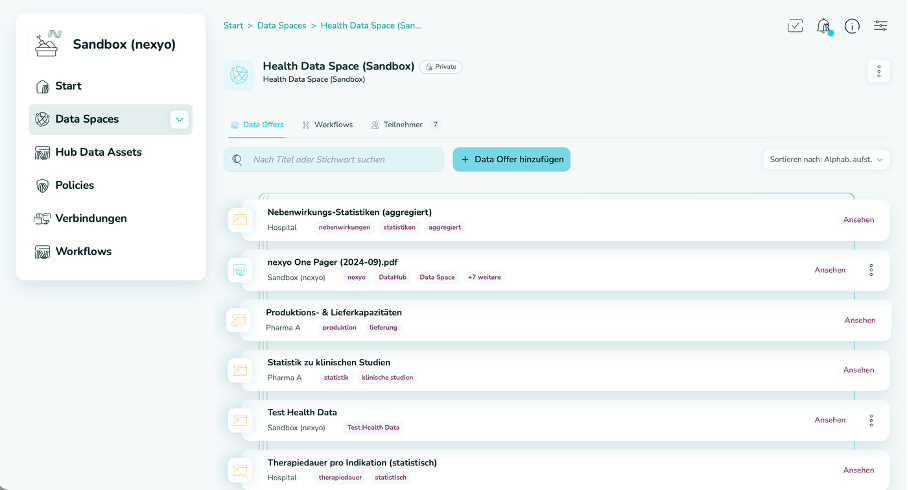
Data assets: FHIR resources with policy control
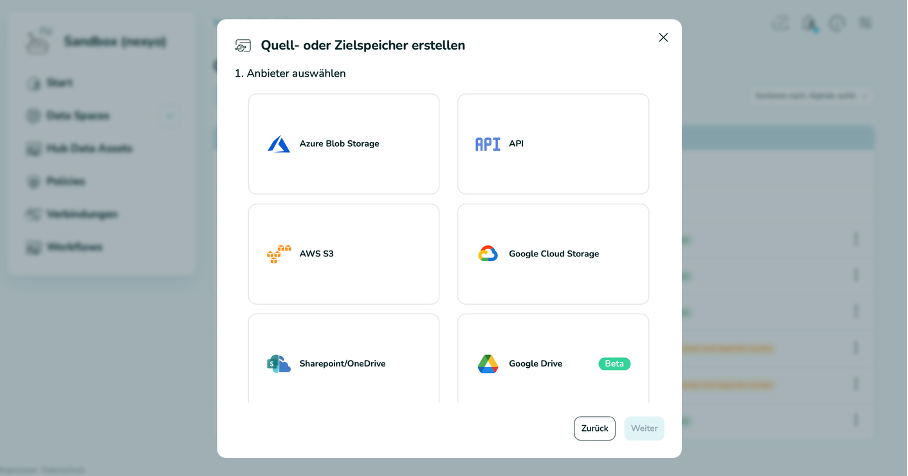
Secure connections between participants
Interactive Demo
nexyo Health Console: experience it live
The Health Console shows how nexyo Trust Infrastructure works in practice: analyze patient data, review governance, track compliance, all in one application.
📊
Patient Analytics
Cohort analysis, diagnosis distributions, age and gender demographics, based on FHIR R4 resources.
🛡️
Governance Dashboard
Health score, trust formula, metadata quality, and asset classification: governance at a glance.
✅
Compliance Tracking
EHDS, GDPR, Data Governance Act, AI Act: compliance scores per regulation, broken down factor by factor.
🤖
AI Health Agent
Ask questions, get answers: the agent knows patient data, standards, governance, and compliance.
Andreas Huber, nexyo GmbH, Ungargasse 46/3, 1030 Wien, Österreich (gemäß § 55 Abs. 2 RStV)
Haftung für Inhalte
Als Diensteanbieter sind wir gemäß § 7 Abs.1 TMG für eigene Inhalte auf diesen Seiten nach den allgemeinen Gesetzen verantwortlich. Nach §§ 8 bis 10 TMG sind wir als Diensteanbieter jedoch nicht verpflichtet, übermittelte oder gespeicherte fremde Informationen zu überwachen. Eine Verpflichtung zur Entfernung oder Sperrung der Nutzung von Informationen nach den allgemeinen Gesetzen bleibt hiervon unberührt. Eine diesbezügliche Haftung ist jedoch erst ab dem Zeitpunkt der Kenntnis einer konkreten Rechtsverletzung möglich.
Haftung für Links
Unser Angebot enthält Links zu externen Websites Dritter, auf deren Inhalte wir keinen Einfluss haben. Für die Inhalte der verlinkten Seiten ist stets der jeweilige Anbieter oder Betreiber der Seiten verantwortlich.
Urheberrecht
Die durch die Seitenbetreiber erstellten Inhalte und Werke auf diesen Seiten unterliegen dem deutschen und österreichischen Urheberrecht. Die Vervielfältigung, Bearbeitung, Verbreitung und jede Art der Verwertung außerhalb der Grenzen des Urheberrechtes bedürfen der schriftlichen Zustimmung des jeweiligen Autors bzw. Erstellers.
EU-Streitschlichtung
Die Europäische Kommission stellt eine Plattform zur Online-Streitbeilegung (OS) bereit: https://ec.europa.eu/consumers/odr. Wir sind nicht bereit oder verpflichtet, an Streitbeilegungsverfahren vor einer Verbraucherschlichtungsstelle teilzunehmen.
Privacy policy available in German only.
Datenschutzerklärung
Gemäß DSGVO (EU) 2016/679
1. Verantwortlicher
nexyo GmbH, Ungargasse 46/3, 1030 Wien, Österreich E-Mail: info@nexyo.io
2. Erhebung und Speicherung personenbezogener Daten
Beim Besuch dieser Website werden automatisch Informationen allgemeiner Natur erfasst (Server-Logfiles): Browsertyp/-version, verwendetes Betriebssystem, Referrer-URL, Hostname des zugreifenden Rechners, Uhrzeit der Serveranfrage, IP-Adresse. Diese Daten sind nicht bestimmten Personen zuordenbar. Eine Zusammenführung mit anderen Datenquellen wird nicht vorgenommen.
3. Kontaktaufnahme
Wenn Sie uns per E-Mail kontaktieren, werden Ihre Angaben zur Bearbeitung der Anfrage und für den Fall von Anschlussfragen bei uns gespeichert. Diese Daten geben wir nicht ohne Ihre Einwilligung weiter. Die Verarbeitung erfolgt auf Grundlage von Art. 6 Abs. 1 lit. b DSGVO.
Das Kontaktformular übermittelt Ihre Angaben an unser CRM-System HubSpot. Anbieter ist HubSpot Ireland Ltd. (Ground Floor, Two Dockland Central, Guild Street, Dublin 1, Irland) bzw. HubSpot, Inc. (USA). Eine Übermittlung in die USA kann erfolgen; HubSpot ist unter dem EU-US Data Privacy Framework zertifiziert, ergänzend gelten die EU-Standardvertragsklauseln. Rechtsgrundlage ist Art. 6 Abs. 1 lit. b und lit. f DSGVO. Mehr in der HubSpot-Datenschutzerklärung.
4. Keine Cookies, kein Tracking
Diese Website verwendet keine Cookies, kein Tracking und keine externen Analysedienste. Es werden keine Schriftarten von externen CDNs geladen (DSGVO-konform, LG München I, Az. 3 O 17493/20). Alle Ressourcen werden lokal bereitgestellt.
5. Hosting
Diese Website wird bei IONOS (1&1 IONOS SE, Elgendorfer Str. 57, 56410 Montabaur) gehostet. Die Server befinden sich in Deutschland. Weitere Informationen: IONOS Datenschutzerklärung.
6. Ihre Rechte
Sie haben das Recht auf Auskunft (§ 15 DSGVO), Berichtigung (§ 16 DSGVO), Löschung (§ 17 DSGVO), Einschränkung der Verarbeitung (§ 18 DSGVO), Datenübertragbarkeit (§ 20 DSGVO) und Widerspruch (§ 21 DSGVO). Zudem besteht ein Beschwerderecht bei einer Aufsichtsbehörde.
7. Änderung der Datenschutzerklärung
Wir behalten uns vor, diese Datenschutzerklärung anzupassen, damit sie stets den aktuellen rechtlichen Anforderungen entspricht. Stand: März 2026.